
“The Hidden Reason Behind Wayanad’s Rising Land Sales”
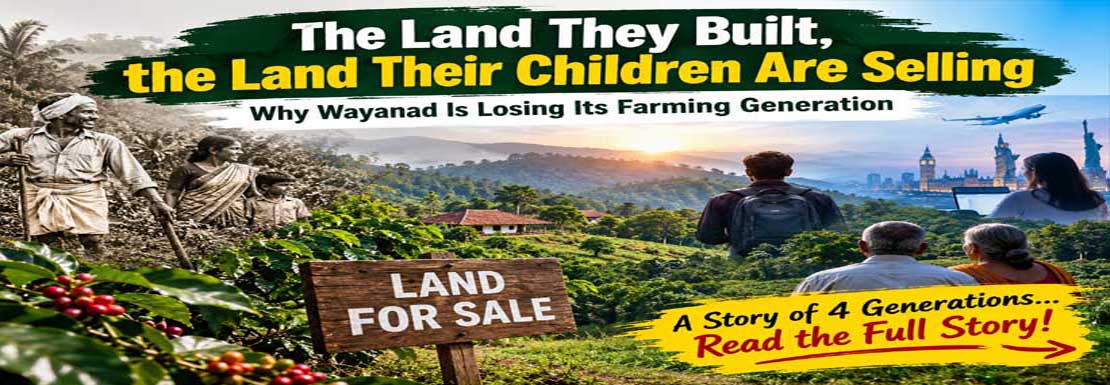
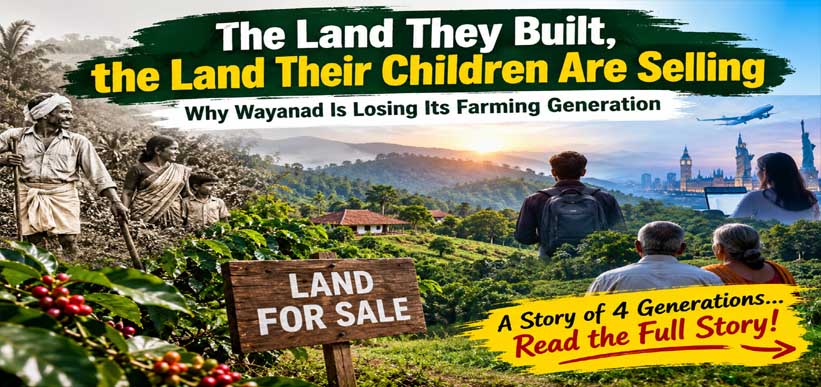 The Land They Built, the Land Their Children Are Selling
Why Wayanad Is Seeing More Large Properties Come Up for Sale
Walk through the villages of Wayanad today and you will see something interesting.
Large coffee plantations.
Old family farms.
Rubber estates.
Paddy fields.
Houses surrounded by acres of land.
And increasingly, you will also see one more thing:
“Property for Sale.”
But why?
Why are families who once worked so hard to acquire and protect acres of land now willing to sell them?
The answer is not simply about money.
It is about generations.
It is about how Wayanad changed—and how the dreams of its people changed with it.
The Generation That Came to Wayanad With Nothing But Hope
To understand today’s Wayanad, we have to go back several decades.
Around the 1950s and 1960s, many families migrated from the Kottayam region to Wayanad.
At that time, farming was a way of life for many families in Kottayam and neighbouring areas. Land was not merely an investment. Land meant survival.
These families came to places such as Nadavayal, Pulpally, Mananthavady, Sulthan Bathery and surrounding areas, looking for agricultural opportunities and a better future.
Many acquired land from traditional landowners, including Jenmis, large families and Devaswom-related holdings.
But buying the land was only the beginning.
The real struggle came afterwards.
Forests and difficult terrain had to be transformed into farms. Roads were limited. Transportation was difficult. Modern machinery was not readily available.
They planted crops.
They built houses.
They raised children.
They survived difficult seasons.
They worked under the rain and the sun.
And slowly, acre by acre, they built their lives.
The Wayanad we see today was shaped by the hands of this generation.
They were not simply landowners.
They were the people who built the agricultural Wayanad.
Then Came the Second Generation
Their children grew up on those farms.
For the second generation, farming was not a business decision.
It was simply life.
They knew the seasons.
They knew when to plant.
They knew how to look after coffee, pepper, rubber, coconut and other crops.
They knew every corner of their property.
The farm was their workplace, their home and their inheritance.
And they continued what their parents had started.
But something was changing.
Their children were going to school.
And education was about to transform Wayanad’s traditional farming families.
The Third Generation: The Children Who Didn’t Need the Land
The third generation grew up with something their grandparents never had in the same way:
Better education and more choices.
Their parents’ farming income paid for their education.
The land provided the foundation.
The children studied.
They became professionals.
They moved to cities.
Then they moved to the Gulf.
Then to the UK.
Then the USA.
Then Australia.
The world became their workplace.
And something unexpected happened.
The sacrifice of the farming generation succeeded.
The parents had always wanted their children to have a better life than they did.
They wanted their children to escape the hardship of farming.
And they succeeded.
But there was a consequence.
The children who benefited from the land no longer needed the land.
The Fourth Generation Doesn’t Even Remember the Farm
This is where the story becomes even more interesting.
The fourth generation is growing up in a completely different world.
Some were born outside Wayanad.
Some grew up in cities.
Some grew up abroad.
They may visit Wayanad during holidays, but farming is no longer part of their daily life.
They don’t know the price of coffee.
They don’t know when rubber should be tapped.
They don’t know how much work is involved in maintaining an estate.
And they certainly don’t want to spend their lives managing several acres of agricultural land.
For them, an inherited property is often not a farm.
It is an asset.
And an asset can be sold.
From Acres to Apartments
This is perhaps one of the biggest changes happening quietly across Wayanad.
The first generation wanted more land.
The second generation wanted to protect that land.
The third generation wanted education and careers.
The fourth generation increasingly wants mobility, convenience and financial security.
A large family property may be worth several crores today.
But maintaining it can be difficult when the owners live abroad.
So the decision becomes practical:
Why keep 10 or 20 acres that nobody in the family is going to manage?
Sell it.
Use part of the money for a child’s education.
Buy an apartment in Kochi or Bengaluru.
Build a modern house.
Invest elsewhere.
Support children abroad.
Fund a marriage.
Create retirement savings.
Or simply divide the inheritance among the next generation.
And suddenly, the land that took one generation decades to build becomes money in a bank account.
The Lonely House in the Middle of the Estate
There is another side to this story that is rarely discussed.
Drive through some of the older farming areas of Wayanad and you may find beautiful large houses sitting in the middle of several acres.
But inside those houses, there may be only an elderly couple.
Their children are abroad.
Their grandchildren are abroad.
The farm that once had a busy family life is now quiet.
There may be CCTV cameras around the property.
Security gates.
Modern houses.
But very few people.
The children call from abroad.
They check on their parents.
Sometimes they even watch the property through security cameras.
Three generations may be connected by technology, but separated by geography.
And the elderly parents are left looking after the land their family once worked together.
Eventually, the question becomes unavoidable:
“What are we going to do with all this land?”
The Land Is Valuable. But Is It Valuable to the Family?
This is the heart of the matter.
Many of these families are not selling because they hate their land.
They are selling because the purpose of the land has changed.
For the first generation, land was security.
For the second generation, land was livelihood.
For the third generation, land became inheritance.
For the fourth generation, land may simply be an investment.
And when an asset no longer serves the family’s lifestyle, selling becomes a logical decision.
This is why some of Wayanad’s largest properties are now entering the market.
A Changing Wayanad
There is another important factor.
Wayanad itself has changed.
Roads have improved.
Tourism has grown.
Property values have increased in many locations.
Education and employment opportunities have expanded.
Young people have moved away.
Agriculture has become more difficult and labour costs have increased.
And land that was once valued primarily for farming is now also viewed for residential, tourism and investment purposes.
As a result, the economic value of certain properties may be much higher today than when the original families acquired them.
For the younger generation, selling a large inherited property can therefore look like a once-in-a-lifetime opportunity.
But There Is a Bigger Question
There is something deeply ironic about this story.
The first generation came to Wayanad because they wanted land.
They worked so their children could have a better future.
Their children got educated.
The next generation went around the world.
And now the descendants of those original farmers are selling the very land their grandparents struggled to build.
The land survived.
The farming tradition did not survive in the same way.
This is not necessarily good or bad.
It is simply what happens when society changes.
Who Will Own Wayanad Tomorrow?
This may be the most important question.
If the traditional farming families continue selling large properties, who will buy them?
Will the land remain with farmers?
Will it be divided into smaller plots?
Will new investors buy large estates?
Will tourism projects come up?
Will farms become resorts, villas and homestays?
Or will a completely new generation of landowners emerge in Wayanad?
We are already beginning to see the answer.
Wayanad’s land market is not just changing hands. It is changing generations.
The people buying land today may be very different from the people who bought it 60 or 70 years ago.
From Farming Families to Global Families
Perhaps the best way to understand this transformation is through one simple journey.
A family came from Kottayam to Wayanad.
They bought land.
They farmed it.
They built a house.
Their children continued farming.
Their grandchildren studied.
Their grandchildren moved abroad.
Their great-grandchildren grew up abroad.
And one day, the family decides to sell the property.
The buyer sees 10 acres of land.
The seller sees four generations of memories.
And somewhere between the two is the story of Wayanad.
The Real Estate Story Behind the Sale
So, when you see a large Wayanad property advertised for sale, don’t immediately assume that the owner is simply looking for money.
There may be a much bigger story behind it.
It could be a family that migrated decades ago.
It could be land cultivated by grandparents.
It could be a farm that supported three generations.
It could be children who now live thousands of kilometres away.
It could be elderly parents who can no longer manage the property.
And it could be the next generation deciding that their future lies somewhere else.
That is why so much land is changing hands in Wayanad today.
Not because the land has lost its value.
In many cases, it is exactly the opposite.
The land has become so valuable that selling it has become a way for one generation to convert the hard work of the previous generation into the future of the next.
Wayanad Is Changing
The first generation came here to build a life.
The second generation stayed to build the farms.
The third generation left to build careers.
And the fourth generation may return only to sell the inheritance.
That is the story unfolding quietly across many parts of Wayanad.
And perhaps, years from now, when we look back at this period, we may realise that we were not simply witnessing a real estate boom.
We were witnessing the end of an era.
An era when a family’s greatest wealth was measured in acres.
Today, that wealth is being measured in education, careers, businesses, houses, apartments, investments—and opportunities across the world.
The land remains in Wayanad.
But the people who built it are slowly moving away.
And that may be the real reason why so many large properties are for sale today.